Healthy Breakfast Choices UK: The Morning Foods Dietitians Warn About (And What to Eat Instead)
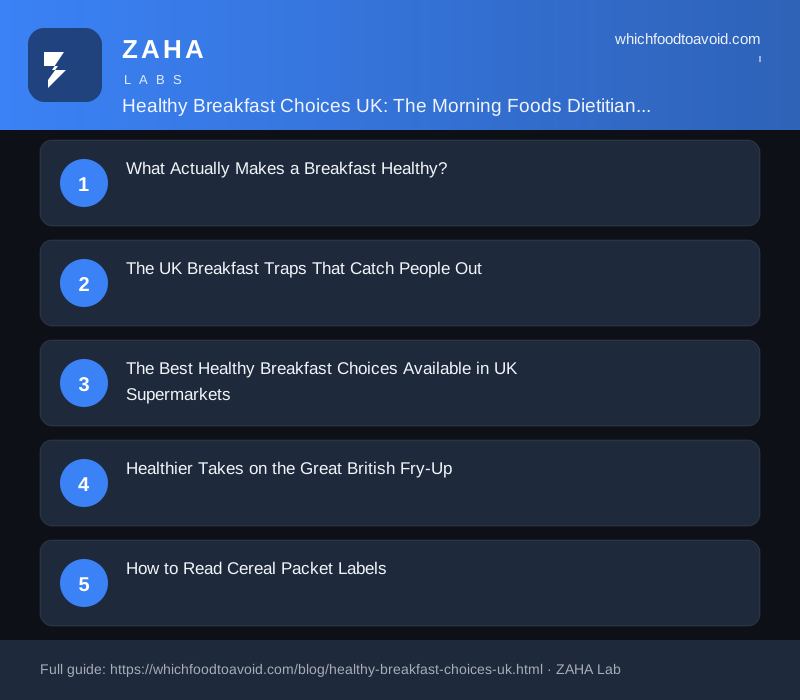
Four in ten British adults who eat breakfast every day are consuming more sugar before 9am than they would knowingly stir into a coffee. The best healthy breakfast choices share three qualities: enough protein to blunt hunger hormones, fibre to slow digestion, and slow-release carbohydrates to keep blood sugar stable until lunch, and most popular UK options quietly fail at least two of those tests.
What Actually Makes a Breakfast Healthy?
NHS guidance recommends a balanced breakfast built on starchy carbohydrates (ideally wholegrain), some protein, and ideally fruit or vegetables. That framework quietly rules out much of what fills Britain's cereal aisles and café grab-and-go fridges.
Three pillars are worth understanding:
- Protein, eggs, plain Greek yoghurt, unsweetened nut butter, suppresses ghrelin, the hunger hormone, which is why a high-protein breakfast leaves you less likely to reach for a biscuit at 11am.
- Fibre, wholegrains, oats, fruit eaten with skin, slows glucose absorption and feeds gut bacteria. UK adults currently average around 18g of fibre daily against a 30g target; breakfast is one of the most consistently wasted opportunities to close that gap.
- Low-to-moderate glycaemic load, this is not about cutting carbohydrates entirely, but choosing ones that don't deliver a sharp spike followed by an equally sharp crash. A bowl of plain porridge oats behaves very differently in the body than a bowl of Frosties, even if the calorie counts look comparable on the packet.
The UK Breakfast Traps That Catch People Out
These are the options that consistently mislead shoppers in supermarkets and cafés across the UK, often because they are marketed using language that implies nutritional virtue:
- Flavoured instant porridge sachets, Quaker Oat So Simple Golden Syrup and most supermarket own-brand equivalents contain 10–15g of added sugar per sachet. Plain rolled oats with your own toppings deliver the same slow-release energy without the sugar load.
- Granola, a standard 45g serving of mainstream granola (Jordans, Dorset Cereals, most supermarket premium ranges) typically contains 8–12g of sugar, usually from honey, glucose syrup, or a combination of dried fruit. It is also calorie-dense while providing relatively little protein.
- Fruit juice, a 150ml glass counts as one of your five-a-day per NHS guidance, but it delivers the sugar of several whole pieces of fruit with almost no fibre. Most people pour considerably more than 150ml, and it is absorbed very quickly without the fibre buffer that eating whole fruit would provide.
- Low-fat flavoured yoghurts, products like Müller Light and most supermarket diet yoghurts compensate for removed fat with added sugar or sweeteners. Full-fat plain Greek yoghurt, Fage, Lidl Milbona, or supermarket own-brand, is nutritionally stronger and more satisfying.
- Breakfast biscuits, BelVita and similar products are positioned around sustained energy, but they are nutritionally closer to standard biscuits than their marketing implies. They are low in protein and tend to be higher in sugar than they appear at a glance.
- Premium smoothie pouches, Innocent, Naked, and similar brands produce fruit smoothies that feel healthy but deliver concentrated fruit sugar without the whole-fruit fibre benefit. They also tend to be expensive for what they provide.
The Best Healthy Breakfast Choices Available in UK Supermarkets
Strong options are available across Tesco, Sainsbury's, ASDA, Lidl, and Aldi without any specialist shopping:
- Plain porridge oats, rolled or steel-cut, cooked with semi-skimmed milk or a fortified oat or soya alternative. Top with a handful of fresh or frozen berries and a tablespoon of unsweetened nut butter to add protein and healthy fat.
- Eggs, scrambled, boiled, or poached on wholemeal toast. Two eggs deliver roughly 12g of protein. Own-brand free-range eggs from Aldi and Lidl are a cost-effective choice.
- Full-fat plain Greek yoghurt with fresh fruit and a tablespoon of mixed seeds, pumpkin, sunflower, or flaxseed. This combination covers protein, fat, fibre, and micronutrients in under three minutes with no cooking required.
- Wholemeal toast with smashed avocado, choose a bread with at least 3g of fibre per slice (Warburtons Wholemeal, Hovis Seed Sensations, or Lidl own-brand wholemeal). Adding a poached egg pushes the protein content up meaningfully.
- Overnight oats, 50g oats, 150ml milk or yoghurt, a teaspoon of chia seeds, and berries prepared the night before. Zero morning effort required, and the cold preparation process may produce a marginally lower glycaemic impact than hot porridge.
Healthier Takes on the Great British Fry-Up
The full English is not inherently off the menu, it is the assembly that creates problems. NHS guidance does not prohibit cooked breakfasts; it encourages reducing saturated fat and salt, both of which are easy to address with a few practical swaps.
- Grill rather than fry bacon, sausages, and tomatoes. Most of the added fat disappears without a meaningful loss of flavour.
- Choose lower-fat sausages, Heck Chicken Italia sausages, or supermarket own-brand reduced-fat pork sausages from Tesco Finest or the M&S Fuller Longer range, reduce saturated fat substantially compared with standard pork varieties.
- Add baked beans, a half-tin of Heinz Reduced Sugar & Salt or a supermarket own-brand equivalent provides around 10g of protein and 7g of fibre, making it one of the most nutritionally efficient items on a cooked breakfast plate.
- Swap white toast for wholemeal, or try a slice of sourdough, which has a lower glycaemic index than standard white bread because its fermentation process partially breaks down starch.
How to Read Cereal Packet Labels
UK food labelling uses a traffic light system per 100g and per portion. When standing in the cereal aisle, three figures are worth checking:
- Aim for under 5g of sugar per 100g, Cornflakes, Rice Krispies, Crunchy Nut, and most children's cereals fail this test.
- Look for at least 6g of fibre per 100g.
- Wholegrain should appear as the first ingredient on the list.
Cereals that reliably pass: Weetabix original, Shredded Wheat, Bran Flakes (check the label, sugar varies by brand), and plain rolled oats. As a rule of thumb, anything with the words frosted, honey, choco, or caramel in the name is unlikely to meet these criteria.
Frequently Asked Questions
Is cereal a healthy breakfast?
It depends almost entirely on the cereal. Most popular UK products, Frosties, Crunchy Nut, Cornflakes, Rice Krispies, are high in sugar and low in protein or fibre. Reliable exceptions include Weetabix (original), Shredded Wheat, and plain rolled oats. When checking a label, aim for under 5g of sugar per 100g and at least 6g of fibre per 100g, with wholegrain listed as the first ingredient.
Is a full English breakfast healthy?
Not in its traditional fully-fried form, but it does not need to be off-limits. Grilling instead of frying, choosing reduced-fat sausages, and including baked beans shifts the nutritional profile considerably. NHS guidance does not prohibit cooked breakfasts, the cooking method, choice of ingredients, and portion size are what typically cause problems, not the format itself.
What is the healthiest quick breakfast from a UK supermarket?
Plain full-fat Greek yoghurt with frozen berries is one of the strongest options available. It takes under two minutes to prepare and delivers protein, fibre, and useful micronutrients without added sugar. Frozen blueberries or mixed berries from Tesco, Sainsbury's, Lidl, or Aldi cost considerably less than fresh equivalents and work just as well. Overnight oats prepared the evening before are another reliable option requiring no morning effort.
Should I eat breakfast if I'm not hungry in the morning?
NHS guidance does not insist that everyone must eat breakfast, and the evidence for it being universally essential is less clear-cut than once thought. If you are genuinely not hungry, forcing a large meal early is unlikely to be beneficial. However, if skipping breakfast consistently leads to poor food choices mid-morning, grabbing a pastry at a coffee shop, for instance, then a small, protein-rich option like a boiled egg or a pot of Greek yoghurt can help stabilise appetite through the morning without feeling like a full meal.